Peptide Science
FDA Peptide Review 2026: What the Latest Compounding Recommendations Really Mean
Six research peptides received support from an FDA advisory committee—but this is not the same as FDA approval.
Contents
- A significant moment for peptide research—but not FDA approval
- What is the Section 503A Bulks List?
- The seven peptides reviewed
- 1. BPC-157
- 2. KPV
- 3. TB-500
- 4. MOTS-c
- 5. Epitalon
- 6. Semax
- 7. Emideltide/DSIP
- Why were these votes important?
- What still needs to happen?
- What does this mean in the United Kingdom?
- What does this mean for peptide research?
- What this means for SPT Peptide
- Conclusion
A significant moment for peptide research—but not FDA approval
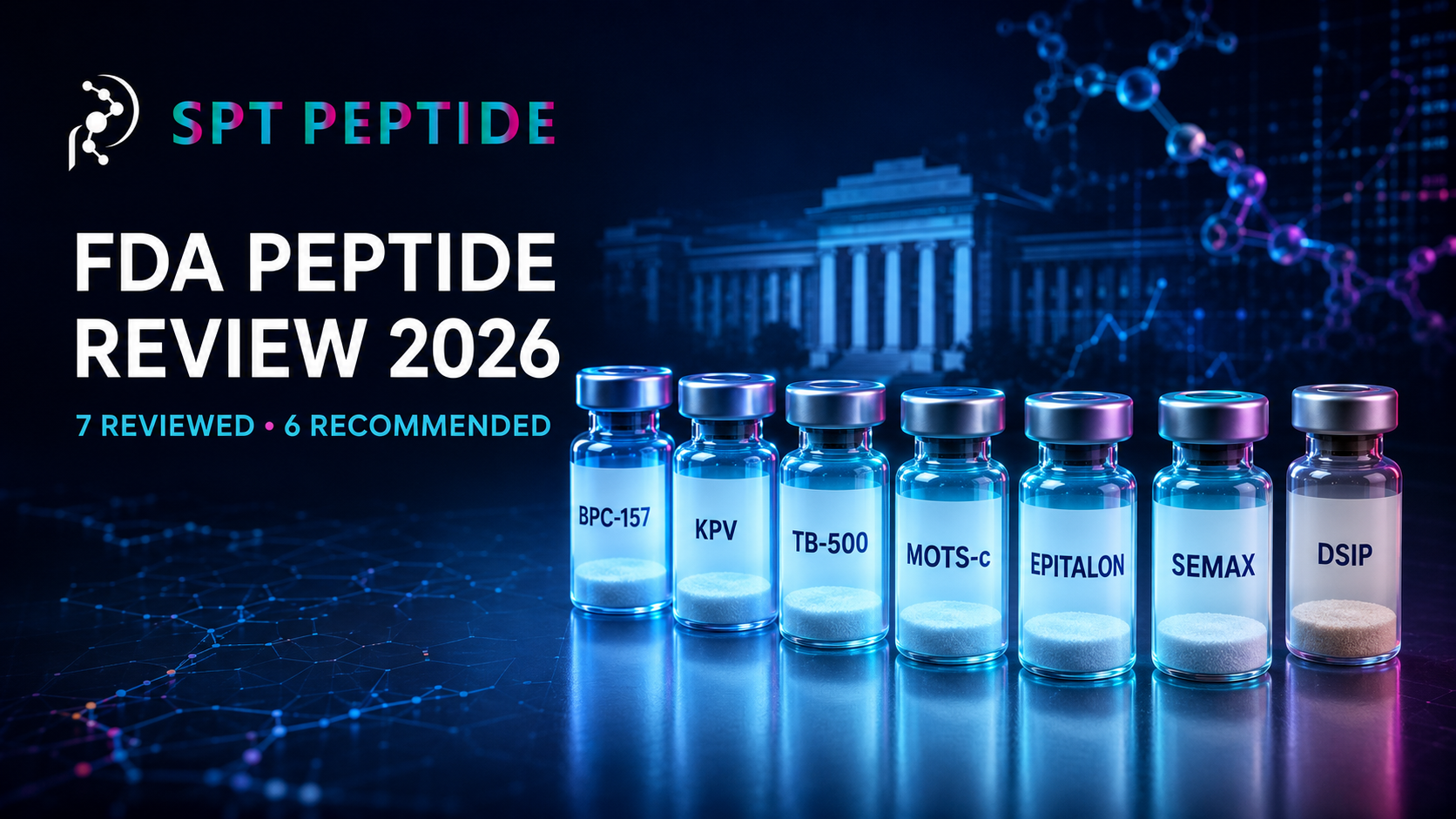
On 23 and 24 July 2026, the US Food and Drug Administration’s Pharmacy Compounding Advisory Committee reviewed seven peptide-related bulk drug substances.
The committee recommended that six should be considered for inclusion on the Section 503A Bulks List:
- BPC-157
- KPV
- TB-500
- MOTS-c
- Epitalon
- Semax
The committee did not support Emideltide, commonly known as DSIP.
Important distinction: These substances have not been approved by the FDA as medicines. The committee issued non-binding recommendations concerning pharmacy compounding. The FDA must still make the final regulatory decisions.
What is the Section 503A Bulks List?
Section 503A of the US Federal Food, Drug, and Cosmetic Act establishes conditions under which eligible pharmacies may prepare patient-specific compounded medicines.
A bulk substance’s inclusion on the 503A Bulks List can permit qualifying pharmacies to use it when specific legal requirements are satisfied.
This does not mean that:
- The substance has completed the normal FDA drug-approval process
- Its safety and effectiveness have been established for general use
- Every proposed application has been approved
- Products containing it may be sold as approved medicines
- Research products automatically become authorised for human use
- The decision applies outside the United States
Compounded preparations are not individually reviewed and approved by the FDA in the same way as licensed pharmaceutical products.
The seven peptides reviewed
| Substance | Area evaluated by the FDA committee | Committee outcome |
|---|---|---|
| BPC-157 | Ulcerative colitis | Recommended for inclusion |
| KPV | Wound healing and inflammatory conditions | Recommended for inclusion |
| TB-500 | Wound healing | Recommended for inclusion |
| MOTS-c | Obesity and osteoporosis | Recommended for inclusion |
| Epitalon | Insomnia | Recommended for inclusion |
| Semax | Cerebral ischaemia, migraine and trigeminal neuralgia | Recommended for inclusion |
| Emideltide/DSIP | Opioid withdrawal, chronic insomnia and narcolepsy | Not recommended |
The areas above are the nominated uses examined during the regulatory review. They should not be interpreted as established benefits or approved medical indications.
1. BPC-157
BPC-157 is a synthetic peptide derived from a sequence associated with a gastric protein.
Preclinical research has examined its possible relationship with:
- Gastrointestinal tissue biology
- Angiogenic signalling
- Tendon and ligament models
- Cellular responses involved in tissue repair
- Inflammatory signalling
For the July 2026 meeting, the FDA review focused on its nominated use in ulcerative colitis.
Although the committee supported its inclusion, BPC-157 has not been approved by the FDA as a treatment for ulcerative colitis, injury recovery or any other medical condition. Much of the publicly discussed evidence remains preclinical.
2. KPV
KPV is a three-amino-acid sequence associated with the C-terminal region of alpha-melanocyte-stimulating hormone.
Research has explored KPV in connection with:
- Inflammatory signalling
- Skin and epithelial biology
- Intestinal barrier models
- Immune-cell responses
- Wound-healing processes
The committee considered nominated applications involving wound healing and inflammatory conditions.
Support for compounding-list inclusion does not establish that KPV is an approved anti-inflammatory or wound-healing treatment.
3. TB-500
TB-500 is generally described in the research marketplace as a synthetic fragment associated with thymosin beta-4 biology. It should not automatically be treated as identical to full-length thymosin beta-4.
Laboratory research has examined related biological pathways involving:
- Actin regulation
- Cell migration
- Angiogenic processes
- Tissue-remodelling responses
- Wound-healing models
The FDA committee reviewed TB-500 in relation to a nominated wound-healing application.
Its recommended inclusion does not constitute approval for sporting recovery, injury treatment, muscle growth or any other therapeutic purpose.
4. MOTS-c
MOTS-c is a mitochondrial-derived peptide associated with cellular energy and metabolic signalling.
Research has investigated its potential relationship with:
- Mitochondrial communication
- Glucose metabolism
- Cellular energy regulation
- Stress-response pathways
- Exercise and skeletal-muscle models
- Age-related metabolic biology
The committee considered nominated applications involving obesity and osteoporosis.
MOTS-c remains investigational. The committee’s vote does not prove that it produces weight loss, treats osteoporosis or improves physical performance.
5. Epitalon
Epitalon—also written as Epithalon—is a short synthetic peptide that has been studied in ageing and circadian-research models.
Research interests have included:
- Circadian biology
- Cellular ageing
- Oxidative-stress responses
- Telomere-associated research
- Sleep-related biological pathways
The committee evaluated Epitalon in connection with a nominated use for insomnia.
The available evidence does not make Epitalon an FDA-approved treatment for insomnia, ageing or longevity.
6. Semax
Semax is a synthetic peptide derived from a fragment associated with adrenocorticotropic hormone, but it is studied primarily for neurobiological rather than corticosteroid activity.
Research has considered its relationship with:
- Neurotrophic signalling
- Cerebral-ischaemia models
- Cognitive and neurological pathways
- Migraine-related biology
- Trigeminal neuralgia
- Oxidative and inflammatory responses in neural tissue
The advisory committee recommended Semax for inclusion by eight votes to five, with one abstention.
Semax is used or recognised differently in certain countries, but it is not currently an FDA-approved medicine in the United States.
7. Emideltide/DSIP
Emideltide is also known as delta sleep-inducing peptide or DSIP.
It has appeared in research relating to:
- Sleep regulation
- Stress-response biology
- Opioid-withdrawal models
- Narcolepsy
- Neuroendocrine signalling
The committee did not recommend its inclusion. Reported concerns included insufficient evidence and unresolved questions surrounding characterisation, safety and effectiveness.
This outcome illustrates that the committee did not simply endorse every substance presented to it.
Why were these votes important?
The recommendations represent an important change in the regulatory conversation surrounding research peptides.
Possible consequences—if the FDA adopts the recommendations—include:
- Greater involvement from regulated US compounding pharmacies
- Stronger expectations for sourcing, identity testing and documentation
- Increased professional and academic interest in peptide research
- More pressure to conduct controlled human clinical trials
- Greater separation between regulated compounding and unverified grey-market supply
- Increased public scrutiny of purity, sterility and manufacturing standards
However, availability through a compounding pathway would not replace the need for properly designed clinical studies.
What still needs to happen?
The Pharmacy Compounding Advisory Committee advises the FDA, but it does not make the final law or approve medicines.
The next stages may include:
- Formal consideration by the FDA
- Regulatory or rulemaking procedures
- Publication of final decisions
- Conditions governing permitted compounding
- Standards for eligible pharmacies and bulk-substance suppliers
- Continuing safety surveillance
- Further review as new scientific evidence becomes available
Until final action is published, businesses should not describe these peptides as newly legal, FDA-approved or authorised medicines.
What does this mean in the United Kingdom?
The FDA regulates products in the United States. Its decisions do not automatically change UK law.
Medicines and healthcare products in the United Kingdom are regulated by the Medicines and Healthcare products Regulatory Agency—the MHRA.
Therefore, the committee recommendations do not:
- Grant UK marketing authorisation
- Make the peptides approved UK medicines
- Authorise their sale for self-administration
- Permit therapeutic or disease-treatment claims
- Remove UK requirements applying to medicinal products
- Change the legal meaning of a research-use-only product
UK businesses must continue to follow applicable UK legislation and MHRA guidance independently of developments in the United States.
What does this mean for peptide research?
Scientifically, the review demonstrates that regulators are engaging more directly with substances that previously sat mainly within preclinical research, specialist compounding and online research markets.
It may encourage:
- Better analytical characterisation
- More transparent manufacturing
- Improved impurity profiling
- Stronger stability research
- Pharmacokinetic studies
- Controlled clinical trials
- More systematic adverse-event reporting
The most meaningful future development would not simply be broader availability. It would be the production of better evidence capable of establishing which compounds are effective, ineffective or unsafe.
What this means for SPT Peptide
SPT Peptide should treat the development as an important research and regulatory update—not as permission to make medical claims.
Product and article pages should continue to state clearly:
- For laboratory research purposes only
- Not for human consumption
- Not intended to diagnose, treat, cure or prevent disease
- Research findings do not establish approved therapeutic benefits
- FDA committee recommendations do not equal FDA approval
- US regulatory developments do not automatically apply in the UK
SPT should also continue prioritising batch identification, Certificates of Analysis, purity documentation and accurate scientific descriptions.
Conclusion
The July 2026 meeting was an important regulatory development, but headlines claiming that the FDA “approved more than ten peptides” are inaccurate.
Seven peptide substances were reviewed. Six received favourable recommendations concerning possible inclusion on a US pharmacy-compounding list, while Emideltide/DSIP did not.
The FDA must still decide what action to take. Even if the recommendations are adopted, the substances will not automatically become FDA-approved medicines.
The development signals growing regulatory recognition of peptide science—but also highlights the continuing need for clinical evidence, quality control and careful communication.
This article is provided for scientific and regulatory education. It does not constitute medical or legal advice. SPT Peptide products are supplied strictly for laboratory research and are not intended for human consumption.